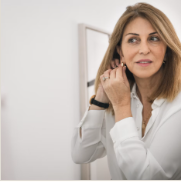
Why clothes can suddenly feel “wrong”
A body does not need to change dramatically for clothing to feel different. A small shift around the waist, hips, bust, shoulders or midsection can change where a waistband sits, where a top ends or how much ease feels comfortable.
That can create a surprisingly frustrating experience: clothes that used to be reliable become the pieces you keep trying on and putting back. The problem is often fit and proportion, not that your entire style has stopped working.
4 things to check before buying anything new
Check the side seams, waistband, bust, upper arms and seat. Pulling in one area does not mean the whole garment is the wrong size.
A top, jacket or trouser can look completely different when its length changes by only a few centimetres. Hem position affects proportion more than many people expect.
More room is not automatically more flattering, and tighter is not automatically more polished. The useful amount is the amount that lets you move while keeping a deliberate silhouette.
Sit down, walk, lift your arms and turn sideways. A garment that only works while standing still is not a practical everyday fit.
Use proportion before you use “body type” rules
The most useful styling decisions are usually about relationships between pieces: long with short, fitted with relaxed, structured with soft. You can change those relationships without changing your personality or chasing a particular “ideal” shape.
The easiest wardrobe reset: fix the high-friction pieces first
Do not empty your wardrobe and start over. Instead, identify the five garments that repeatedly make getting dressed annoying. Those pieces tell you where the real problem is.
Small adjustments that can change an outfit
- Change the hem. A trouser that hits at the wrong point can make the entire outfit feel off.
- Change the rise. If waistbands feel uncomfortable, try a different rise rather than simply sizing up.
- Open the layer. An unbuttoned cardigan, shirt or jacket creates a strong vertical line without requiring tight clothing.
- Use a belt deliberately. A belt can define a waist, but it can also simply provide a visual break between top and bottom. It should feel comfortable, not restrictive.
- Use a tailor when the garment is worth saving. Small alterations can be more effective than replacing an otherwise excellent piece.
5 outfit formulas that adapt well to changing proportions
What about the changing waist?
This is one of the most common reasons familiar clothes suddenly become less comfortable. The practical response is not to force yourself back into an old waistband. Look at where the garment is designed to sit and whether the rise, fabric and waistband construction suit you now.
For jeans and trousers, try several rises while keeping the rest of the outfit similar. For dresses and skirts, check whether the waist seam is sitting at the right anatomical point rather than assuming a different size will solve it. And if you simply prefer less pressure around your middle, that is a legitimate comfort preference — you do not need a styling justification for it.
When online shopping gets harder
Changing proportions make online fashion especially tricky because a product photograph cannot tell you how the garment will behave on your body. Treat the listed measurements as data, not decoration.
Compare a favourite pair of trousers or jacket with the size chart rather than relying only on the size label.
Stretch, drape and structure can matter as much as the nominal size.
Colour, length, size, seller and stock can change within the same Amazon listing.
For a new cut, buying only when the return conditions are clear reduces the risk of a wardrobe orphan.
A better definition of “flattering”
Flattering is often treated as if it means making the body look smaller. That is a narrow definition. A more useful test is whether the outfit creates a silhouette that feels balanced, intentional and comfortable to you.
That might mean showing your waist. It might mean not showing it at all. It might mean wearing a wide trouser, a straight jean, a soft dress or a structured jacket. The best choice is the one that gives you the visual effect and physical comfort you actually want.
The three-question fitting test
Three practical tools worth having
These products were chosen for specific wardrobe problems, not because you need more things. A full-length mirror helps you assess the whole silhouette; fashion tape can solve small temporary gaps or movement issues; and a belt can deliberately change the relationship between top and bottom.
01 — See the whole silhouette: VEVOR 1650 × 558 mm Full-Length Mirror
A full-length mirror is useful because fit problems are often proportional. The VEVOR model is a tall, arched mirror that can be used freestanding, leaned or wall-mounted. For dressing, the practical benefit is simple: you can assess the complete outfit rather than judging each garment in isolation.
02 — Fix small wardrobe annoyances: Linda's Essentials Fashion Tape
Fashion tape is not a substitute for correct sizing, but it can be useful for temporary fixes such as a small blouse gap, a neckline that shifts or a hem that needs to stay in place. The 100-strip version is compact enough to keep with your wardrobe or travel kit.
03 — Change the visual break: JasGood Women's Leather Belt
A belt can create a deliberate transition between top and bottom, define a waist when you want one or simply give a tonal outfit a stronger finishing detail. The JasGood belt on the linked Amazon listing is available in multiple sizes and colours, so the exact selected variant matters.
Style guidance informed by AARP's current fashion guidance for women over 50, particularly its emphasis on fit, proportion and adaptable silhouettes: AARP — Foolproof Fashion Tips for Women Over 50.
Product details checked against current Amazon.de listings and manufacturer/marketplace information on the linked products. Prices, sellers, delivery estimates, stock and variants can change.
More from Better After 45
Make getting dressed easier by building a wardrobe around real life, repeatable combinations and pieces that work with your current fit preferences.