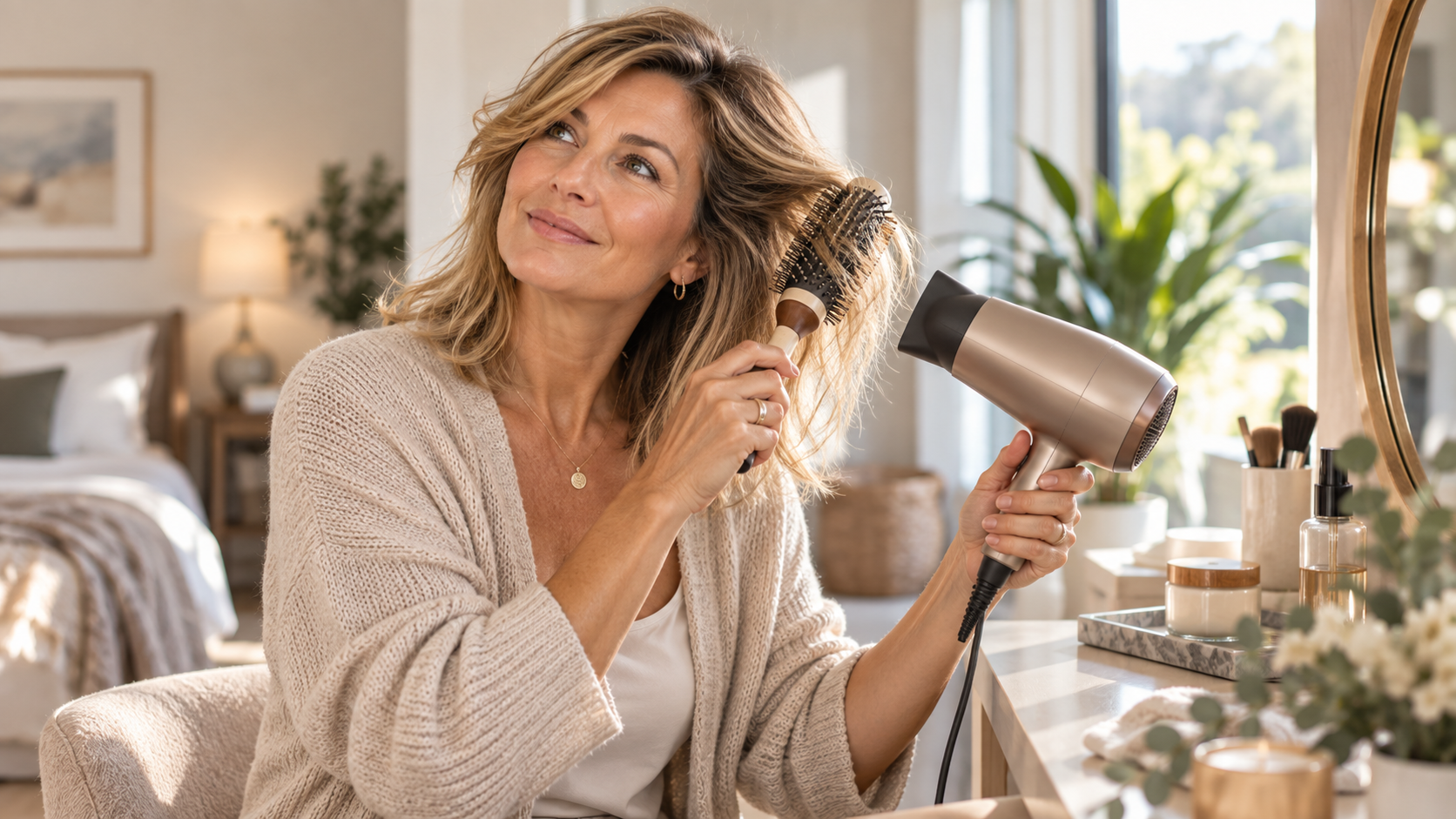
Fine hair and thinning hair are not exactly the same thing
Fine hair describes the diameter of individual strands. Thinning hair describes reduced density or coverage. You can have fine hair without significant hair loss, and you can have thinning hair with strands that are not especially fine.
That distinction matters because styling can improve the appearance of fullness, but it does not diagnose or treat the reason hair density has changed.
5 things that make thinning-looking hair look flatter
Oils, rich creams and too much conditioner close to the roots can reduce lift. Keep richer products mainly on the lengths and ends when you need them.
Ultra-sleek hair can reveal the scalp more clearly. A little movement and separation can create a fuller-looking result.
More heat is not a shortcut to better volume. Use the lowest effective setting and keep the dryer moving rather than concentrating heat on one area.
Very long fine hair can lose shape under its own weight. Excessive layers can also make already-sparse ends look less substantial.
Concentrate effort at the crown, parting and front sections. The rest can stay relatively simple.
The 7-minute fuller-looking hair routine
This is a styling routine, not a treatment. The objective is to create shape quickly while minimizing unnecessary pulling and heat.
How to create volume without making the hair feel “done”
The most convincing volume is usually uneven on purpose. The crown can have lift while the sides remain relatively smooth. The front can have a little movement while the ends stay clean.
- Lift before you smooth. Once the roots are flattened, adding more product rarely fixes the underlying shape.
- Work in sections. A few small sections around the crown are easier to control than the whole head.
- Keep the product close to the job. Root powder belongs at the roots; conditioner belongs mainly where the hair needs softness.
- Use your hands as a finishing tool. Fingers can separate and lift without repeatedly pulling a brush through the finished style.
- Stop early. If the hair already looks fuller, another round of brushing can undo the work.
What about the haircut?
Styling cannot completely overcome a haircut that removes the visual weight you need. For fine hair, a strong perimeter and controlled layering can often make the ends look more substantial than heavily layered lengths. The best choice depends on your actual density, texture, face shape and how much styling you are willing to do.
A useful salon conversation is not simply “make my hair look thicker.” Explain where you want fullness — crown, sides, fringe or ends — and how much daily styling you are realistically prepared to maintain.
Be especially gentle when the hair is wet
Wet hair is more vulnerable to stretching and breakage. The American Academy of Dermatology recommends handling wet hair gently, reducing excessive heat and avoiding styles that constantly pull on the hair.
Three useful tools for this routine
These products each solve a different part of the styling problem. None is a treatment for hair loss, and you do not need all three. Think of them as targeted styling tools: root texture, gentler detangling and easier blow-styling.
01 — Schwarzkopf Taft Volume Powder
This 10 g styling powder is designed for immediate volume and natural movement. Schwarzkopf says to work a small amount into dry hair, concentrating on the roots; the product is designed not to weigh the hair down and is rated by the manufacturer for up to 50 applications.
02 — Tangle Teezer Fine & Fragile Ultimate Detangler
This large detangling brush is designed specifically for fine, fragile and color-treated hair. Its softer flex teeth are intended to reduce pulling and breakage while detangling wet or dry hair.
03 — BaByliss Air Power Volume AS95E
The AS95E combines drying and styling in one tool and offers three temperature settings, two speed settings and two round-brush attachments. It can be used on wet or dry hair, making it practical for a full blow-dry or a quick refresh. Use the lowest effective heat and keep the tool moving.
When styling is not the whole story
If your hair is gradually becoming less dense, styling can improve how it looks, but it cannot tell you why the change is happening. A widening part, noticeably thinner ponytail, patchy loss or sudden increase in shedding deserves more attention than simply buying another volumizing product.
Persistent or progressive hair loss can have many causes. If the change is significant, sudden, patchy or concerning to you, consider discussing it with a dermatologist or other qualified healthcare professional.
AAD — Hair styling without damage.
AAD — Female pattern hair loss.
Schwarzkopf Taft — Volumen Powder.
Tangle Teezer — The Ultimate Detangler Fine & Fragile.
BaByliss — Air Power Volume AS95E. Product availability, sellers, prices and Amazon variants can change.
More from Better After 45
Keep the routine practical: start with the basics, then add one targeted styling step only when it solves a real problem.